
The Tale of Two Cities: Kochi and Muziris
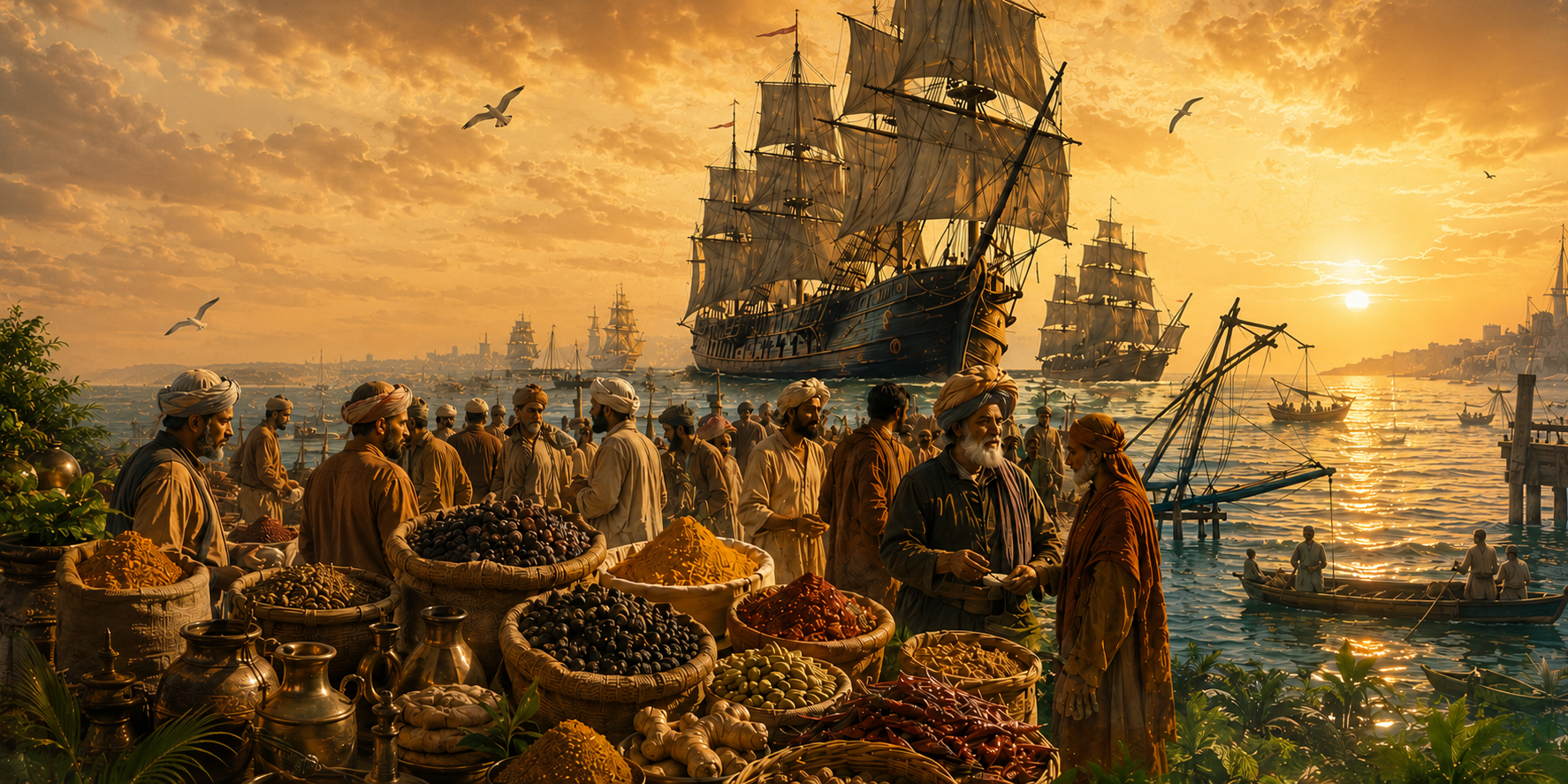
Some cities exist in geography, while others live on in memory. Muziris belongs to both. More than 2,000 years ago, Muziris stood as one of the most important ports in the ancient world. Roman texts such as The Periplus of the Erythraean Sea describe ships arriving from the Mediterranean, carrying gold, wine, and glassware, and returning laden with pepper, “black gold.” Muziris was not merely a marketplace; it was a meeting ground. Cultures did not collide here—they conversed. Religion, language, and identity coexisted in a fragile yet beautiful balance. Then, sometime around the 14th century, floods altered the course of the Periyar River, and Muziris gradually faded from maps. But its spirit did not vanish—it migrated.
It found a new home in Kochi.
Kochi inherited more than geography; it inherited memory. The Portuguese arrived in 1500, followed by the Dutch and the British. Jews, Arabs, and Chinese traders left their imprint. Today, within just a few kilometers, one can see a synagogue, a church, a mosque, and a temple standing in quiet harmony. Kochi is not Muziris reborn. It is Muziris remembered.
The Idea Behind the Biennale
In 2012, that memory found a new language through the Kochi-Muziris Biennale—India's first biennale of international scale. Conceived by artists Bose Krishnamachari and Riyas Komu, and supported by the Kochi Biennale Foundation, the event was not just about exhibiting art—it was about reactivating a city’s cultural memory.
Globally, biennales such as the Venice Biennale set the precedent. But Kochi’s version carries a different soul. It was not born in a polished metropolitan capital—it emerged from weathered warehouses, salt-laced air, and centuries-old streets.
The word biennale means “every two years,” but in Kochi, it feels more like a heartbeat—cyclical, reflective, and evolving.
From its first edition, the Biennale drew global attention. Over time, it has hosted more than 400 artists from over 100 countries, with each edition featuring around 60–90 artists and collectives. What began as an experiment has now become one of the largest contemporary art festivals in Asia.
The Concept: A Living, Breathing Ecosystem
The Kochi-Muziris Biennale is not confined to galleries—it spills into everyday life. From the colonial facades of Fort Kochi to the spice-scented warehouses of Mattancherry, the city itself becomes both canvas and collaborator. Today, even the Kochi Metro and local institutions—schools, cafés, and transport networks—participate, carrying art into everyday rhythms.
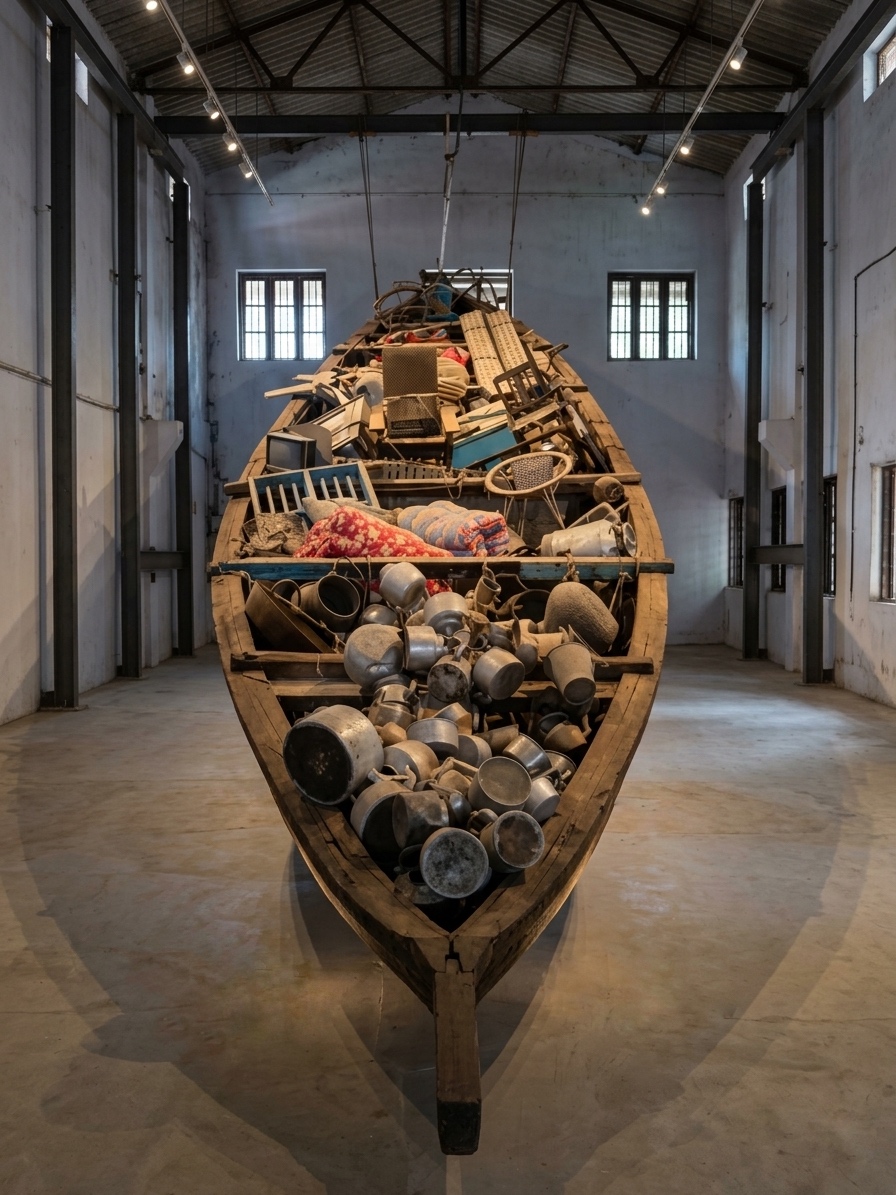
Picture Source: Image clicked by the author at the Kochi-Muziris Biennale exhibition.
Each edition revolves around a curatorial theme, often exploring identity, migration, climate, memory, and coexistence. The sixth edition, for instance, imagines the Biennale as a “living ecosystem”—where art is not static but evolving, unfinished, and deeply relational.
This idea echoes the legacy of Muziris. Where ships once carried spices, today ideas travel. Where traders once exchanged goods, artists now exchange perspectives. The medium has changed, but the philosophy remains the same: openness creates meaning.
The Artist Engages: Voices from the World
To walk through the Biennale is to encounter the world—unexpectedly and intimately.
Artists like Ai Weiwei bring political introspection. His installations, often built from everyday materials, quietly question authority, freedom, and identity. You stand before them, and slowly, they begin to unsettle your certainties.
Then there is Yayoi Kusama, whose mirrored infinity rooms dissolve the boundary between self and space. You enter as an observer and leave as part of the artwork.
Global participants over the years have included Anish Kapoor, Olafur Eliasson, Marina Abramović, and William Kentridge, each bringing a distinct voice and perspective.
Yet, the most powerful collaborations often happen quietly.
A local carpenter in Fort Kochi helps build a large-scale installation. A student volunteer translates conversations between an international artist and a neighborhood resident. Electricians, fabricators, and artisans—hundreds engaged during each edition—become co-creators.
This is not art on display. This is art constructed together.
How Art Builds a Sustainable Society
Numbers tell one story. Emotions tell another story. Kochi tells both.
The Biennale attracts massive footfall—over 600,000 visitors in earlier editions, rising to approximately 6.6 lakh (660,000) visitors in recent editions within a span of just three to four months.
But the real impact lies beneath these numbers.
1. Local economy: Hotels, homestays, cafés, and small businesses experience significant growth.
2. Employment: Hundreds of artisans and workers find seasonal and skill-building opportunities.
3. Tourism multiplier effect: Visitors stay longer and engage more deeply, increasing per capita spending.
Unlike conventional economic models, this growth distributes itself. It reaches the tea seller, the auto driver, and the craftsperson.
Aligned with Sustainable Development Goal 11 (Sustainable Cities and Communities), Kochi demonstrates how culture can drive inclusive urban development. Heritage buildings are restored, not replaced. Public spaces are reimagined, not erased. Education becomes central as students, schools, and local communities actively engage.
Art becomes accessible—not exclusive.
And something intangible happens: people begin to see their city differently.
There is pride.
There is belonging.
There is identity.
The Way Ahead: Art in an Unstable World
We live in a fractured time. Wars redraw borders. Societies polarize. Identities harden. Dialogue weakens.
In such a world, spaces like the Kochi-Muziris Biennale are not luxuries—they are necessities.
Art does something politics often cannot: it creates empathy without argument. It allows us to stand inside another person’s reality, even if only for a moment.
Kochi, once again, becomes a meeting point of worlds, just as Muziris once was. But today, instead of spices and silk, it trades in ideas, questions, and possibilities.
The challenge ahead is not simply to sustain the Biennale but to deepen its impact by expanding community participation, strengthening global cultural dialogue, integrating sustainability and climate consciousness into artistic practice, and ensuring that art remains accessible beyond elite audiences.
In a divided world, Kochi offers a quiet yet powerful proposition:
That coexistence is possible.
That dialogue is still alive.
That culture can heal where systems fail.
Conclusion: A City That Breathes Through Art
Kochi during the Biennale feels different. The air carries stories. The streets feel like conversations. The past and present no longer stand apart—they intertwine.
Muziris may have disappeared, but its spirit endures—in every installation, every conversation, and every visitor who walks through Kochi’s historic lanes.
This is not just the story of an art festival.
It is the story of continuity.
A reminder that when we nurture culture, it does not merely decorate life—it sustains economies, shapes societies, and gives cities a soul.

Copyright © 2026. Rajagiri Business School. All Rights Reserved. Website Designed and Maintained by Intersmart