


The senior executive of a popular global technology firm in Silicon Valley, known for its data-driven people management philosophy, had just wrapped up a long team meeting with the company’s board. His team was part of a redundant business, which the company was planning to discontinue in the coming months due to the economic slowdown and market uncertainty. The executive was asked to identify team members whose positions would be eliminated. This meant an imminent layoff, where a lot of his team members who dedicatedly worked hard in the past year could be jobless. As an empathetic leader, the senior executive started leveraging his network to seek opportunities for his team members, with many of his team members getting successfully placed. The following week, the management communicated the layoff decision to the team members individually. In a stark irony, the senior executive who was involved in the layoff process and who actively helped his team in the job search process was himself laid off.
Through the 2030 agenda for sustainable development adopted in 2015, the United Nations emphasizes the sustainable development goal “Decent Work and Economic Growth” (SDG8) as “opportunities for everyone to get work that is productive and delivers a fair income, security in the workplace and social protection for families, better prospects for personal development and social integration” (UN, 2015). Instances such as the senior executive’s layoff expose a clearly evident paradox between the UN’s decent work agenda that highlights job security, fairness, and respect for human dignity, and the organization’s dire need for economically rational decisions.
Tech layoffs are not isolated to specific firms or geographies, but they reflect a worldwide labour market recalibration driven primarily by business cycles, rapid technology adoption, or shifts in strategic priorities, and in no way reflect employee competence or effort. The digital boom instigated by the Covid-19 pandemic witnessed a massive surge in the adoption of digital technologies that drove aggressive expansion of tech firms, necessitating them to expand their headcount to capture this growth. However, the normalization of demand post-covid, creating excess capacity in teams, and the shift in macroeconomic conditions, such as tightened global liquidity and rising interest rates, along with the investor and shareholder pressure for profit margins, acted as major reasons for the recent wave of layoffs that kickstarted in 2023. Driven by sustained digital adoption, AI integration, and cost optimization pressures, the layoffs continue to affect millions of employees worldwide, from Silicon Valley tech giants to IT service providers in India.
According to the Sustainable Development Goals Report 2025, the global unemployment rate fell to a record low of 5% in 2024 (UN, 2025); however, the share of workers in informal employment has been constantly edging upwards since 2015. In 2024, about 58% of the global workforce was informally employed, with another 38 million expected to enter informal employment in 2026 (UN, 2025). These figures strongly indicate a substantial proportion of the workforce that remains inadequately protected in terms of social security coverage, legal protection, and workplace safety measures. The youth (aged 15-24) unemployment rate remains at 12.9% in 2024, which is triple the adult rate of 4% (UN, 2025). The report also indicates that one in five young people (aged 15-24) globally were Not in Education, Employment, or Training (NEET) in 2024. The NEET figures for women are twice those of men, demonstrating the reduced opportunities for women as well as the disparities and vulnerabilities of the labour market.
These issues are particularly relevant to the Indian IT sector, which is labour intensive and still largely dependent on offshore projects. The Indian IT sector employs 5.8 million people (Nasscom, 2025), of which 20% is Gen Z (born between 1997 and 2012). As per the Periodic Labour Force Survey, 2023–24, nearly 58% of regular salaried employees in India do not have a written job contract, a figure that is estimated to exceed 70% among tech sector employees, reflecting a high degree of informal employment (PLFS, 2024).
How Do Layoffs Challenge Decent Work and Economic Growth?
Layoffs have an unequivocal but unequal impact on employees in different countries at different levels (junior, middle, and senior), with women and contract workers raising concerns about equity and inclusion. Layoffs foster a climate of uncertainty, affecting employee morale, productivity, and long-term career planning. Contrary to the core idea of decent work that emphasizes stability and social and legal protection, layoffs force employees to take up gig work and contract roles, which often lack social protection and benefits. This also adds up to financial strain that results from reduced household income, leading to use of savings and provident funds and delayed EMIs and rent. In developing countries with limited social security systems, layoffs can push families to financial distress. Layoffs also often widen economic and social inequalities (SDG10), as job losses are concentrated in specific sectors or cities, leading to migration pressures and uneven economic development.
The Road Ahead
“With just five years to reach the Sustainable Development Goals, we need to shift into overdrive.”
- António Guterres, Secretary-General, United Nations
Even though the sustainable development goals show remarkable progress from 2019 to 2025 (Fig. 1), with some notable gains and improvements in millions of lives worldwide, as the 2030 deadline approaches, the progress still remains far from sufficient (Fig. 2).
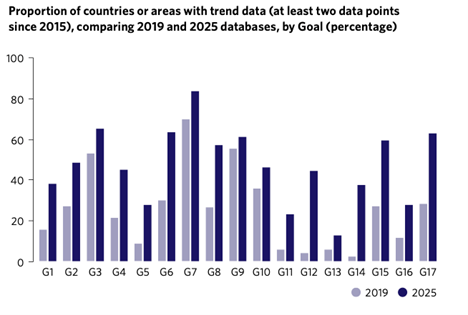
Fig 1: Proportion of countries or areas, comparing 2019 and 2025
(Source: https://unstats.un.org/sdgs/report/2025/The-Sustainable-Development-Goals-Report-2025.pdf)
In a rapidly evolving labour market, most recent layoffs are driven not by a shortage of talent but by a shortage of skills, underscoring the need for continuous reskilling and upskilling. While conventional technologies and routine jobs give way to digital technologies and creative jobs, education systems should move beyond degrees, and employers and policymakers should share the responsibility of enabling workers to transition into new roles. When layoffs happen without structured reskilling and training, it not only undermines the objective of Quality Education (SDG4), which emphasizes inclusive and equitable education for all, but also erodes the long-term employability and decent work prospects.
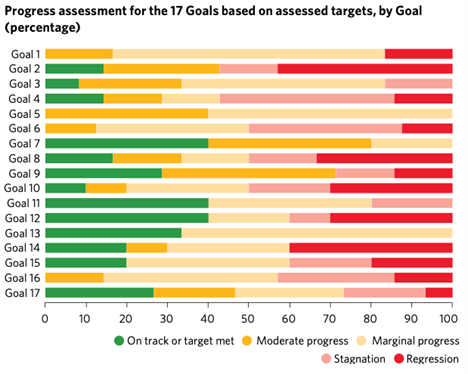
Fig 2: Progress Assessment for the 17 Goals
(Source: https://unstats.un.org/sdgs/report/2025/The-Sustainable-Development-Goals-Report-2025.pdf)
When viewed through the lens of the UN’s sustainable development goals, layoffs reveal the apparent tension between economic efficiency and human dignity. Nevertheless, layoffs are less disruptive when skills evolve faster than technology, organizations are supportive, and growth is inclusive rather than extractive. The goal is not to stop economic change but to instigate growth, innovation, and restructuring by managing transitions humanely. This would not be possible without stronger policies and structural reforms that focus on expanding job quality and access to quality education and training.
References:
Greg Bensinger (2026), Amazon plans thousands more corporate job cuts next week, sources say, Economic Times HR World, https://hr.economictimes.indiatimes.com/news/workplace-4-0/talent-management/amazon-plans-thousands-more-corporate-job-cuts-next-week-sources
UN (2015), UNSDG : https://sdgs.un.org/goals
Nasscom (2025),Strategic Review 2025: https://nasscom.in/knowledgecenter/publications/technology-sector-indiastrategic-review-2025#
PLFS. (2024). Periodic Labour Force Survey Report, Government of India. https://www.mospi.gov.in/sites/default/files/publication_reports/QuarterlyBulletinPLFS_July_September_2024.pdf
UN. (2025), The Sustainable Development Goals Report, 2025,
https://unstats.un.org/sdgs/report/2025/The-Sustainable Development-GoalsReport-2025.pdf
Uddin (2025), The Impact of Layoffs on Organizational Culture and Employee Morale in IT Companies, Journal of Informatics Education and Research 5(1)
Harvard Business Review, October 2024, Research: The Long-term Costs of Layoffs, https://hbr.org/2024/10/research-the-long-term-costs-of-layoffs
Siang (2024), What’s the Right Way to Carry Out Layoffs, MIT Sloan Management Review, https://sloanreview.mit.edu/article/ask-sanyin-whats-the-right-way-to-carry-out-layoffs/

Copyright © 2026. Rajagiri Business School. All Rights Reserved. Website Designed and Maintained by Intersmart