


“In the midst of every crisis lies great opportunity."
-Albert Einstein
Introduction
Any crisis arrives unannounced, fractures routines, shakes institutions, and forces societies to confront uncomfortable truths. Yet history shows that crises are not merely periods of disruption—they are powerful turning points that expose institutional weakness. When a system disrupts, it exposes hidden vulnerabilities. At the same time, they also open rare windows to rethink priorities, design institutions, and reinvent the way we live and work. In many ways, such interruptions have repeatedly become catalysts for breakthroughs and innovation.
Examples such as the COVID-19 pandemic, geopolitical conflicts such as the Russian-Ukraine War, and trade tensions between the US and China are a few instances that illustrate how crises help in reshaping markets, policies, and firm behavior.
The Covid-19 pandemic began as a global health emergency and quickly expanded into lessons in sustainability and resilience. It underscored the urgency of SDG-3 (Good health and well-being), revealed the fragility of global supply chains, highlighted deep social inequalities, and accelerated conversations around SDG-9 (Industry, innovation, and infrastructure). The geopolitical conflict between Russia and Ukraine exposed system fragility, highlighting SDG-2 (Zero Hunger), SDG-7 (Energy Access), and SDG-16 (Institutions). Before the political tension, Russia dominated around 35 percent of Europe’s pipeline natural gas exports. The 2022 Russian invasion of Ukraine disrupted European gas markets, highlighting the fragility of global supply chains and overdependence on concentrated energy and food sources.
The tech and trade tensions between the US and China demonstrated the fragility of globalization when it disintegrates. Before the trade tension, fragmented globalization was considered a global value chain that involved trading in intermediate goods and international trade policies. This impacted SDG-9 (Industry), SDG-8 (Growth), and SDG-17 (Partnerships).
Once the risk becomes apparent, they reprice the market, regulated by policymakers and internalized by firms. Consider the pandemic: within months, digital adoption leaped forward by nearly a decade. Remote work, telemedicine, and online education became mainstream, reshaping industries and lifestyles. Similarly, the 2008 financial crisis, though devastating, sparked the rise of fintech, strengthened regulatory frameworks, and pushed sustainable finance into the spotlight.
Thus, this article explores how contemporary crises disrupt sustainable development goals. However, we reframe these breakdowns as breakthroughs that catalyze pathways for resilience, innovation, and sustainable growth.
Understanding the crisis
Crises are interconnected, reinforcing, and systemic. Scholars refer to the global landscape as a "polycrisis," characterized by financial instability, geopolitical conflicts, and technological fragmentation. These crises expose deep structural vulnerabilities across economies, institutions, and development systems, directly threatening the progress of sustainable development goals (SDGs).
1. COVID-19 : a multi-dimensional systemic shock
Crises do not appear suddenly; they manifest through long-ignored fractures and pressures. COVID-19 and the growing number of climate disasters are strong reminders that today's problems are systemic, connected, and have a wide range of effects. Their impacts on global health (SDG-3) and infrastructure innovation and industry (SDG-9) demonstrate how vulnerabilities can rapidly escalate into global emergencies.
Before COVID-19, everyone was raving about the progress of the health system with respect to improved life expectancy (from 66.8 years in 2000 to 73.1 years in 2019), increased vaccination, and achievements in disease management. However, COVID-19 highlighted the systemic pitfalls globally with the sharpest reversal on life expectancy in many countries. COVID-19 pushed global life expectancy down by 1.8 years between 2019 and 2021 (71.4 years and 61.9 years, respectively).
Moreover, COVID-19 is not merely a health issue, but it has become a multidimensional systemic shock affecting health, economy, education, and infrastructure simultaneously. This impact made the policymakers realize that the traditional health system was unprepared for global-scale disruptions and that digital infrastructure was no longer optional but necessary.
2. Ukraine War: Energy & Food System Vulnerabilities
Before the Ukraine war, global energy and food systems operated under highly optimized but fragile supply chains, with significant dependence on a few key exporters. Russia was a major supplier of natural gas to Europe, while Ukraine and Russia together accounted for a substantial share of global wheat, fertilizer, and sunflower oil exports. This concentration created efficiency but masked underlying vulnerabilities.
During the war, the impact was immediate, widespread, and deeply systemic. Energy prices surged sharply as gas supplies from Russia to Europe were disrupted, forcing countries to rely on expensive alternatives like LNG and even revert temporarily to coal. At the same time, global food systems faced severe shocks—Ukraine’s blocked ports and reduced agricultural output led to shortages of wheat, maize, and sunflower oil, driving up global food prices. Fertilizer supply disruptions further worsened agricultural productivity, especially in developing countries.
Prior to the invasion, Ukraine’s share in the global food system accounted for 10 percent of global wheat exports, 13 percent of barley exports, and more than 50 percent of the global market for sunflower oil. The outbreak of war in 2022 disrupted these tightly coupled systems. Ukraine’s grain production and export declined by 25 percent in 2022 and led to dramatic rises in global food prices. The outbreak of the war actually affected those countries that depended on Ukraine and Russia for the wheat and fertilizer imports. The decoupling effect adversely affected the vulnerable countries as it increased the poverty due to shortage in food supply, rising cost, and heightened food insecurity, affecting SDG-2, zero hunger; dependent on imports, they faced shortages, rising costs, and heightened food insecurity.
This situation qualifies as a crisis because it exposed systemic fragility at a global scale, where localized conflict triggered widespread economic and humanitarian consequences. It undermined SDG 2 (Zero Hunger) and SDG 7 (Energy Access), while also destabilizing governance systems linked to SDG 16 (Peace, Justice, and Stronger Institutions), revealing the risks of overdependence and lack of diversification.
Inflation rose globally, straining household incomes and increasing poverty risks. Import-dependent nations in Africa and Asia were particularly vulnerable, facing both food insecurity and energy shortages. Additionally, the crisis triggered currency pressures, fiscal stress, and increased government intervention in markets.
Overall, the war transformed a regional conflict into a global economic and humanitarian crisis, simultaneously affecting energy security, food systems, and macroeconomic stability. Thus, the war in Ukraine is a three-dimensional crisis as per United Nations sustainable development indicators. It affects food, energy, and finance. Almost 36 countries count on Russia and Ukraine for more than half of their wheat imports. The war has caused prices to rise, which has affected the poorest and most vulnerable countries in the world.
3. US–China Tech & Trade Tensions: Fragmented Globalization
For decades, globalization was built on efficiency, specialization, and interdependence, particularly in high-technology sectors such as semiconductors, electronics, and digital infrastructure. However, US–China tensions disrupted this equilibrium by introducing export controls, investment restrictions, and technology bans that fragmented previously seamless supply chains. The semiconductor industry, for instance, became a focal point of strategic competition, where restrictions on critical inputs and technologies created bottlenecks across multiple industries worldwide.
This fragmentation increased production costs, delayed innovation cycles, and introduced uncertainty for firms dependent on cross-border collaboration. More importantly, it weakened multilateral cooperation and trust, replacing economic interdependence with strategic rivalry. When a system designed for global efficiency begins to generate instability, inefficiency, and geopolitical risk at scale, it transitions into a crisis—one that directly affects industrial growth (SDG 9), employment and economic stability (SDG 8), and global partnerships (SDG 17).
This disruption was most visible in semiconductors, electronics, automotive, telecommunications, and advanced manufacturing, all of which depend heavily on globally fragmented supply chains. The semiconductor sector became the epicenter of the crisis—global chip shortages during 2020–2023 led to production losses of over 10 million vehicles worldwide, costing the automotive industry more than $200 billion. Export controls on advanced chips and equipment further constrained firms’ access to critical technologies, delaying innovation cycles in AI, 5G, and high-performance computing.
Electronics and telecom industries also faced rising costs and supply uncertainties as firms like Huawei were restricted from accessing key components. According to global estimates, supply chain disruptions and geopolitical tensions contributed to increased production costs by 10–20% in some manufacturing segments. Additionally, global FDI flows showed signs of fragmentation, with investments increasingly shifting toward “friendly” nations rather than efficiency-driven destinations.
These developments illustrate how cross-border technological interdependence transformed into a source of systemic risk, reinforcing the crisis across industrial growth (SDG 9), economic stability (SDG 8), and global partnerships (SDG 17).
The takeaway is simple: modern crises are interconnected. Health emergencies spill into education and labor markets; energy shocks ripple through food systems and geopolitics; climate extremes amplify humanitarian need. Understanding crises as system-level stress tests is the essential first step to converting disruption into durable progress.
Breakdown into breakthrough: crisis as a catalyst
COVID-19 accelerated the major shifts not only to SDG 3 but also substantiated the impact on SDG 9. Worldwide, telemedicine adoptions surged, which expanded access to remote care. Digitalization, including digital finance, becomes a transformative shift. Most countries recognize their weaknesses in disease surveillance, early warning systems, and health emergency preparedness, and they are working to strengthen them.
The Ukraine war triggered structural transformations across energy, food, and financial systems. The disruption of Russian gas supplies pushed countries, particularly in Europe, to rapidly accelerate investments in renewable energy, energy efficiency, and hydrogen, shifting the energy transition from a climate priority to a strategic necessity (SDG 7, SDG 13). Simultaneously, the crisis led to the rapid expansion of LNG infrastructure and diversification of global energy trade, creating a more resilient energy architecture (SDG 9). In food systems, supply shocks encouraged the adoption of precision agriculture, alternative inputs, and localized sourcing strategies, enhancing resilience (SDG 2). Firms also reconfigured global supply chains through near-shoring and friend-shoring, prioritizing stability over efficiency (SDG 8, SDG 12, and SDG 17). Additionally, financial sanctions accelerated interest in digital currencies and alternative payment systems. Thus, the war transformed systemic disruptions into opportunities for resilience, innovation, and structural realignment.
In response to the tech-tension crisis, governments and firms adopted a range of strategic measures to rebuild resilience and reduce dependence on concentrated supply chains. Countries such as the United States, China, and members of the European Union significantly increased investments in domestic semiconductor manufacturing, supported by industrial policies like subsidies and incentives. Firms simultaneously restructured their supply chains through near-shoring and friend-shoring, prioritizing geopolitical stability over pure cost efficiency. There was also a strong push toward supply chain transparency, digital tracking systems, and compliance standards, improving traceability and accountability in production networks.
These measures have strengthened SDG 9 (Industry, Innovation & Infrastructure) by fostering local manufacturing ecosystems and technological capabilities. The creation of new industrial hubs and strategic sectors has supported SDG 8 (Decent Work & Economic Growth) through job creation and skill development. Moreover, diversified and transparent supply chains contribute to SDG 12 (Responsible Consumption & Production), while new forms of strategic alliances and trade partnerships reinforce SDG 17 (Partnerships for the Goals).
Thus, the crisis not only disrupted globalization but also accelerated a transition toward more resilient, sustainable, and strategically aligned economic systems.
Comparative Analysis: Crisis Vs. Breakthrough
Each case illustrates a consistent pattern from breakdown to breakthrough. It shows that crises expose the system's vulnerabilities. And the nature of the majority crisis is multidimensional, which will result in a strategic adaptation. The strategic responses during the crisis period open the pathway for transformation rather than disruption.
The following table summarizes how the economy underwent a transition process during the crisis period and its quick strategic responses.
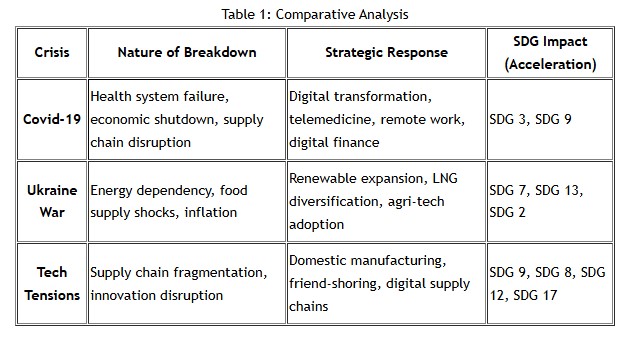
Thus, crises evolve as disruptions that drive transitions towards resilience, sustainability, and diversification.
Conclusion
The main characteristic of a crisis is that it is only a temporary disruption. A crisis always serves as a pivotal moment that reshapes global development. In the beginning stage of crisis, it exposes vulnerabilities, but slowly it accelerates innovation, institutional reforms, and sustainable transformation. Hence, Covid-19 reshaped the digital and healthcare systems, the Ukraine war accelerated energy transition and food resilience, and tech tension redefined globalization.
References
Huang, G., Guo, F., Liu, L., Taksa, L., Cheng, Z., Tani, M., & Silva, S. S. M. (2024). Changing impact of COVID-19 on life expectancy 2019–2023 and its decomposition: Findings from 27 countries. SSM-Population Health, 25, 101568.
International Energy Agency (IEA). (2023). World Energy Outlook 2023. Paris: IEA.
International Monetary Fund (IMF). (2023). World Economic Outlook: Navigating Global Divergences. Washington, DC: IMF.
Organisation for Economic Co-operation and Development (OECD). (2023).
Global Supply Chain Resilience Report. Paris: OECD.
United Nations Development Programme (UNDP). (2023). Sustainable Development Goals Report 2023. New York: UN.
World Bank. (2023). Global Economic Prospects. Washington, DC: World Bank.
United Nations Conference on Trade and Development (UNCTAD). (2023).
World Investment Report 2023. Geneva: UNCTAD.

Copyright © 2026. Rajagiri Business School. All Rights Reserved. Website Designed and Maintained by Intersmart